Agentic intelligence, built on a deterministic foundation.
Nomain turns your mainframe into a multi-level knowledge graph, an ontology-driven digital twin of your systems: business, architecture and code, and every thread between them.
A knowledge layer that compounds
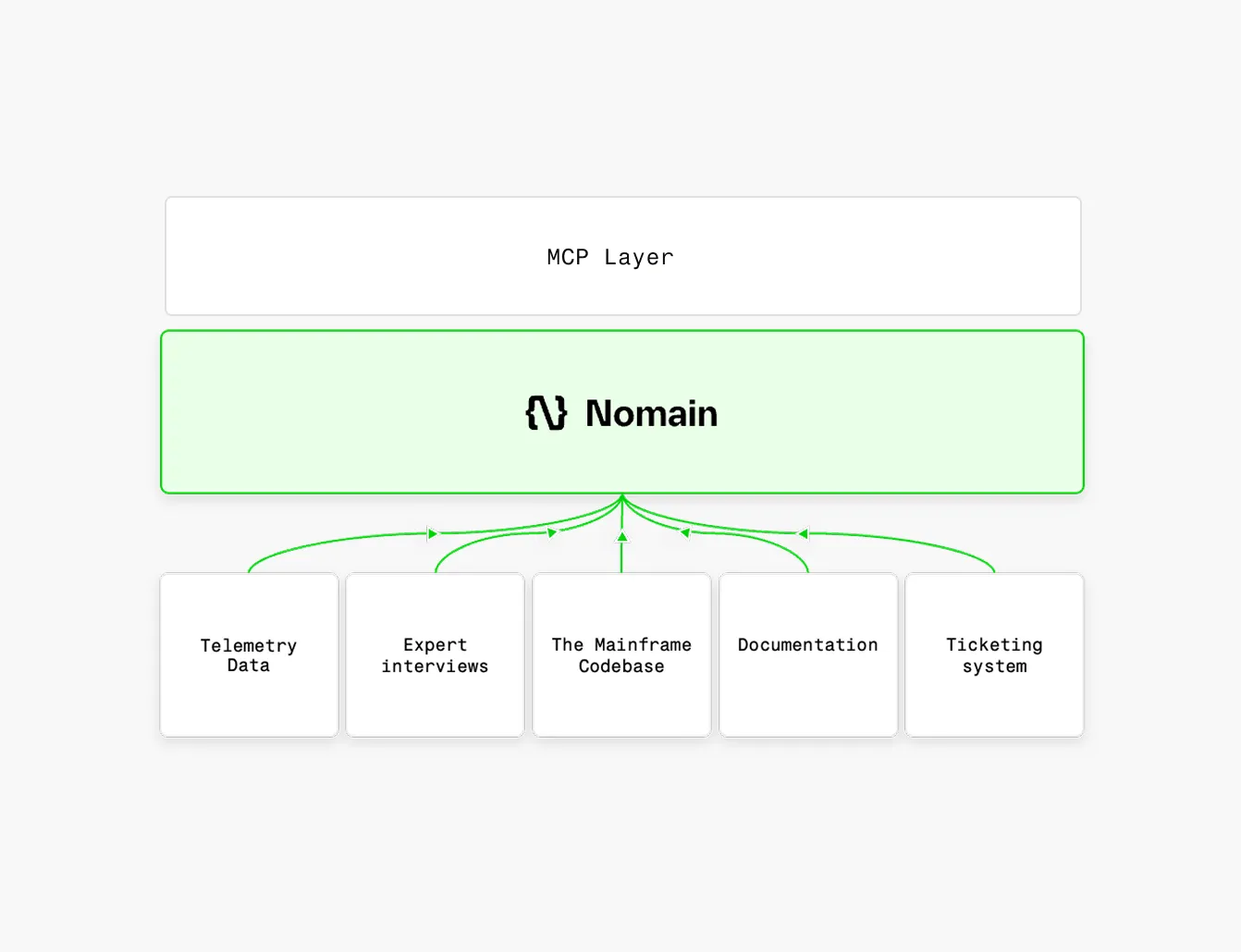
The Nomain platform builds turns your legacy estate into a knowledge graph, combining static analysis with AI analysis to produce deterministic, transparent knowledge across the whole team. The Knowledge Graph gives a precise structural view of the code. We enrich it with expert interviews, telemetry, and documentation, so the output reflects not just what the system does but why. This also enables the use of Nomain by business teams along with technical teams.
That layer is not a one-off scan. As people use Nomain, the questions they ask, the entities they pin, and the paths they follow feed back into it, so the quiet knowledge that never gets written down accumulates instead of evaporating. The layer gets richer the more your teams work in it, and both technical and business sides keep access to the knowledge that matters.
And it stays yours. Everything Nomain captures is exportable, feeding your documentation, your downstream systems, and your AI agents, or moving with you if you change tools. No lock-in, and the audit trail is something you can produce outside the platform when DORA asks for it.
Platform features
Discover the core features of the Nomain Platform
Business logic & process extraction
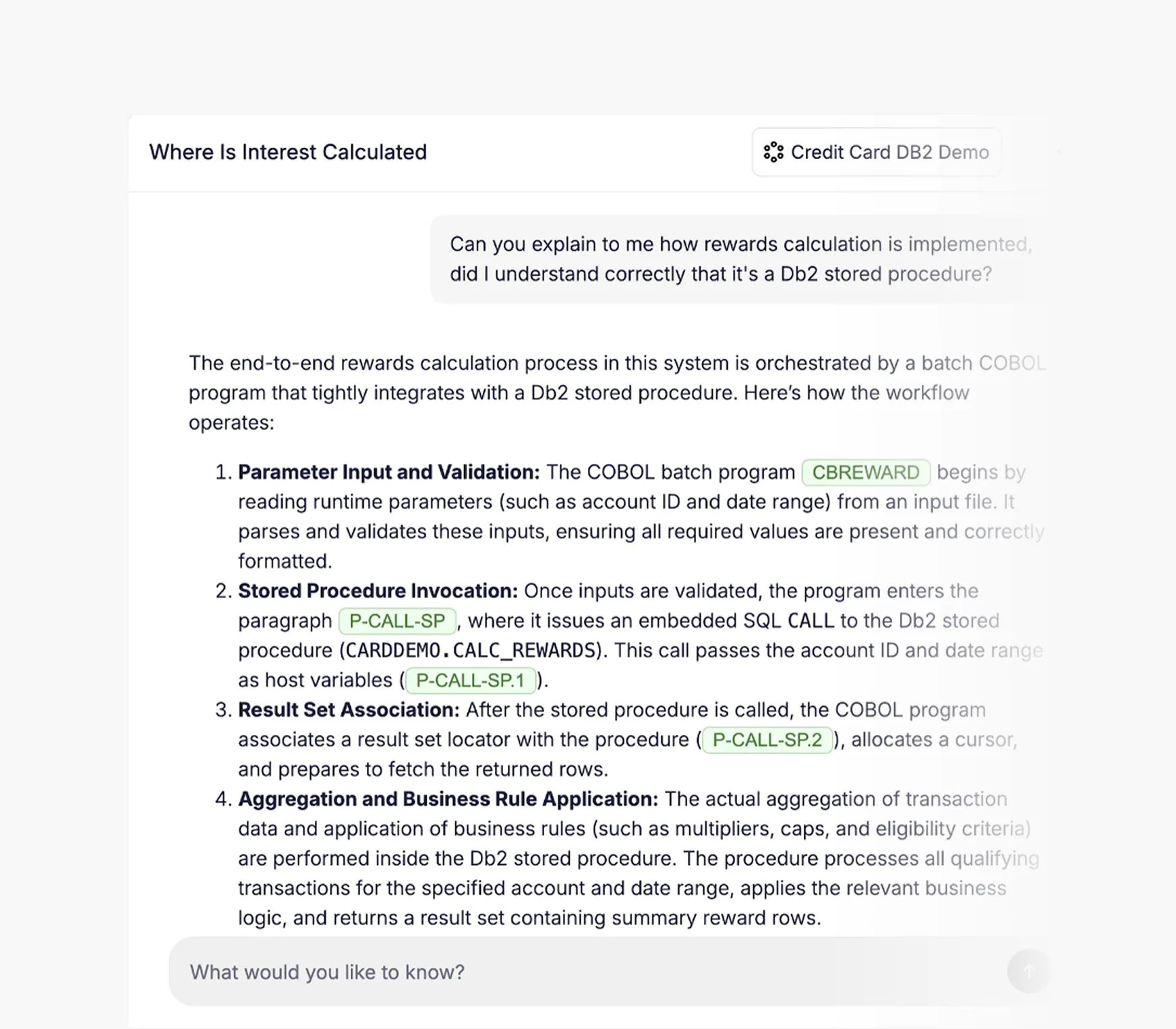
Two layers of knowledge are buried in the code and lost when their authors leave. The structure, which business domains the system covers and how work flows across them, and the rules inside it, the calculations, conditions, and edge cases. Nomain reconstructs both grounded in the actual code, not in someone's recollection. The rule-level view is also what DORA's transparency expectations require.
How: System visualisation renders the domains and flows as a navigable map, Monolith decomposition separates intertwined logic into discrete business capabilities, and Chat & Explore lets you ask for any rule in plain language and trace it to the exact line that defines it.
Impact analysis
Changing legacy code without the original authors is the main reason modernisation stalls. Nomain shows everything a change touches before you make it, so the risk is visible rather than discovered in production.
How: System visualisation surfaces every dependency tied to the component, and Chat & Explore lets you interrogate the ones that matter.
Incident resolution
When something fails at three in the morning, resolution depends on whether the one person who knows that subsystem is reachable. Nomain lets any engineer trace a failure to root cause without that person on the call.
How: Copy-paste your incident report into Nomain or connect Nomain to your ticketing system directly via MCP and get a root-cause analysis.
Success cases
Error-source lookup a general-purpose assistant could not complete
A developer needed to find where a screen error message originates, after a colleague had made no progress searching with a general-purpose coding assistant. Nomain returned the answer directly and the developer applied a quick fix.
Three days of manual work, 52 seconds with Nomain
A team ran an impact analysis to find which programs would be affected if the length of a field changed. The manual search took three days. They then asked Nomain, which returned the correct answer in 52 seconds.
Production incident resolved without technical support
A business specialist received a ticket for an incident reporting that a period update API call had failed. He asked Nomain what to do and resolved the ticket on Nomain's suggestion to attempt a retry, without taking development team time.
Frequently asked questions
The essentails covered
What does Nomain actually do?
Nomain is a knowledge platform for legacy code. We connect directly to your mainframe code base (or other legacy systems), build a deterministic knowledge graph (Abstract Syntax Tree) from it, enrich it with other data (like scheduler configs, telemetry data, documentation) and provide an interface where both developers and business analysts can ask questions about how the system works. This creates an always up-to-date knowledge layer which can be used for a host of use-cases. The goal is to make your existing system transparent again, so the people who work with it every day can actually understand what it does and why.
Which language model does Nomain use?
Nomain is not a general-purpose LLM, but an AI system. Under the hood, there are five distinct tasks where LLMs are applied, and each has its own validation set we use to benchmark any available model. We run these evaluations regularly to ensure we always have the best-performing model for each task. Currently, we use a mix of models from OpenAI, Anthropic, and IBM Granite. Open-source models are closing the gap with proprietary ones, and we track that closely.
Which programming languages do you support?
Right now we support COBOL and PL/1, along with all the relevant mainframe languages like JCL and DDL. Java and C# are supported too and adding modern languages is significantly easier than legacy ones because the tooling standards are better. If your environment includes something more exotic, we figure that out together during a pilot project. New language support requires dedicated work from our side, but it is not a blocker for getting started.
How does pricing work?
Our pricing consists of a fixed platform fee, which covers the basic functionality of “understand your mainframe”. Additional modules for optimization or compliance can be added when needed in a flexible way, ensuring fair and transparent pricing for every customer. Pilot projects are always fixed price and depend on the project scope. We are happy to walk through the specifics for your situation.
Where does Nomain run? Can we keep our code on-premise?
Both cloud and on-premise deployments are fully supported. In practice, most of our customers in insurance and banking prefer to run Nomain in their own cloud or on-premise, because mainframe source code is highly sensitive information. We understand that. Nomain is available on the AWS Marketplace for easy cloud deployment, and we also support Azure. For customer infrastructure installations, we provide the infrastructure scripts and work with your team to get everything running locally. No code or data needs to leave your environment.
Can Nomain be used for systems beyond the mainframe?
Yes. While we started with mainframe languages because that is where the pain is most acute, the underlying platform works for any large code base. Analyzing both, a legacy mainframe system and a new systems being built to replace it, is a strong use-case for Nomain. This makes sense, because understanding the gap between old and new is often the hardest part of a migration.
Can Nomain help with migration from COBOL to Java?
We have the technical foundation to support code translation (for example, generating Java from COBOL), but we don’t believe that is the right approach. The risk of producing output that looks correct but behaves differently is still too high, even with the best models available today. Hence, our approach is a domain-driven migration, where the code base is split into functional domains, which can serve as a knowledge layer for creating the same domains and functionality in a new tech stack.
We saw a similar demo from a large, well-known vendor. How is Nomain different?
The short answer is focus and architecture. We built Nomain from day one as an AI-native knowledge layer for both business and tech users. The larger vendors started with services or tooling that predates modern AI, and have since added AI capabilities on top. Our knowledge graph approach provides deterministic, traceable answers rather than relying on a general-purpose language model to interpret code. Beyond the technology, the practical difference is flexibility. Our company lives or dies based on how well we help our customers achieve their goals. For the large incumbents, mainframe tooling is one product among hundreds. For us, it is the entire business.
How long does it take to get started?
Nomain is deployed in your cloud environment, which typically takes a few weeks to set up. After that, we run a kick-off to align on project targets and verify support for your specific technology stack.
A standard Pilot runs three months of active testing, where your developers and business analysts work with Nomain on real code in day-to-day operations. For organizations that want a lighter first step, we also offer Proof-of-Concept projects: four to six weeks, focused on a smaller slice of your codebase, running in Nomain's cloud environment. In both cases, the setup effort on your side is minimal.
How does this connect to DORA?
DORA, formally Regulation (EU) 2022/2554, has applied across the EU financial sector since 17 January 2025 and puts direct obligations on how financial entities manage ICT third-party risk. The documented knowledge layer and the traceable mapping back to your code, is yours and stays in your environment and it keeps sensitive code and analysis inside your own perimeter removes an entire category of third-party data exposure from the equation. It also gives you traceability to the code line, which supports the auditable, defensible documentation that operational resilience work depends on.
Why does sovereignty matter specifically for legacy analysis?
Because the analysis target is the crown jewels. COBOL, PL/I, JCL, and DB2 logic encodes how the institution actually calculates risk, prices products, and moves money. Tools that depend on shipping that code to a third-party LLM endpoint create a data path that is hard to audit and harder to defend to a regulator. Nomain is built in the EU, deterministically on an AST-first architecture, which means the analysis does not depend on sending code to an external model. Hence the European sovereign deployment is not a bolt-on, it follows from how the product is designed.